
19 November 2026
With a focus on implementation at COP31, BDN is emerging as a critical tool for delivering quality infrastructure. Across multiple conversations and two events at COP31 Türkiye, BDN focused attention on building demand for quality infrastructure investment and strengthening human capital development.
As industries and economies navigate the dual pressures of growing infrastructure demand and mitigating its impact on the planet, the discussions in Türkiye showed that quality infrastructure is about far more than the assets themselves. It is about the policies that shape investment, the standards that build trust, and the people who build, maintain, and benefit from what is delivered.
On 10 November, the Blue Dot Network convened a high-level breakfast discussion bringing together senior policymakers, investors, project developers, and representatives from international organisations to examine how procurement, certification, and financing can work together to deliver more resilient and sustainable infrastructure outcomes.
Discussions highlighted the importance of getting the conditions right for market solutions to emerge. This means a combination of technical specifications in infrastructure contracts, market signalling and building sufficient demand to bring prices down, and policy and regulatory frameworks that shape market incentives and investment decisions. Procurement, in particular, has a pivotal role to play in embedding policy priorities and quality objectives into infrastructure delivery. Participants explored how the combination of these approaches can accelerate innovation and market demand for low-impact materials, strengthen supply chain resilience, and support the transition to sustainable infrastructure systems.
Reflecting the Blue Dot Network’s broader focus on infrastructure quality, participants emphasised the need to move beyond a project-by-project perspective and adopt sector-wide strategies capable of driving systemic change. By aligning policy, finance, and quality standards at scale, such approaches can help mobilise greater investment, strengthen market confidence, and accelerate the delivery of quality infrastructure across regions and sectors. Blue Dot Network’s certification framework, grounded in global principles, provides a common approach to operationalising quality in infrastructure and finance contracts in order to drive scale.
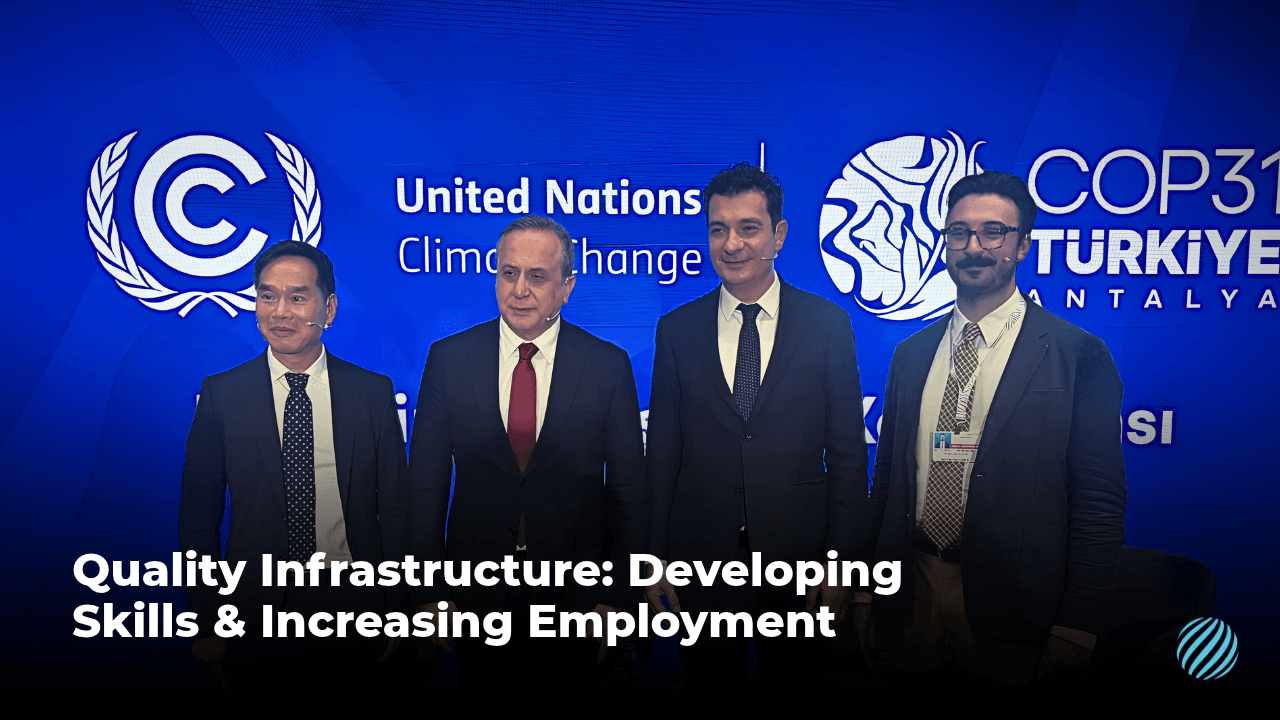
On 14 November, BDN hosted Quality Infrastructure: Developing Skills and Increasing Employment at the Türkiye Pavilion, exploring how quality infrastructure development drives upskilling, workforce development, and long-term capacity building. The session opened with a certification ceremony recognising two recently certified BDN projects.
Among them was the Gülpınar Wind Power Plant, a 39-turbine wind energy project developed and operated by ERN Holding in Türkiye. The project stands out for its contributions to renewable energy and climate objectives, its robust biodiversity management framework, and its integrated approach to environmental, social, and human rights considerations.
Accepting the certification, Ali Koray Erden, Head of International Business Development at ERN Holding, emphasised: “For ERN Holding, this certification is not a badge. It’s not a marketing tool. It’s our everyday operational standard and the exact blueprint we intend to follow for all our infrastructure investments moving forward.”
His remarks underscored one of the core objectives of the Blue Dot Network’s certification: to provide an incentive and roadmap for project developers and investors to embed quality standards in a project’s design and implementation from the outset, and to encourage them to strive for outperformance and continuous improvement.
The TN Sunrise One project, which was recently certified during the BDN Promoting Quality Infrastructure in Southeast Asia seminar in Bangkok, was also recognised during the ceremony. TN Sunrise One is a 15 MW solar power project developed under the India Renewables Development Platform, a joint venture between Private Infrastructure Development Group (PIDG) and Radiance Renewables. The project is the first BDN-certified project in India, and it forms part of a broader platform that aims to develop between 110-150 MW of renewable energy capacity across India. Its certification demonstrates how the Blue Dot Network framework can be applied not only to individual infrastructure assets, but also to scalable investment platforms designed to accelerate the deployment of quality, sustainable infrastructure at scale.
Following the certification ceremony, Stuart Cannon (PIDG), Ali Koray Erden (ERN Holding), Murat Gücüyener (Eurasia Tunnel) and Edwin Lau (BDN Secretariat) explored how quality infrastructure development is founded on the calibre of its labour force, and what institutional and project capabilities are needed to prepare bankable, high-quality infrastructure that attracts investment, transfers technical skills, creates jobs and economic development, and delivers long-term value to local communities.
Beyond the spreadsheet. Ali Koray Erden shared that the true quality and success of an infrastructure asset goes beyond the spreadsheet, whether that means financial modelling or financing structures. It depends heavily on good management and the careful preparation needed to turn something like a power plant into a machine that creates local jobs and develops skills. Investor trust, he noted, begins with responsible management and clear rules, and winning that trust means following the highest environmental and social standards. In practice, this includes field surveys before construction begins so that the concerns of local communities are considered. When local execution is backed by global protections, he argued, an ambitious project moves from talk to reality.
Skills transfer was central to ERN Holding’s approach at Gülpınar. The turbines were purchased from Germany, and German engineers travelled to Türkiye to train local engineers in maintaining them, building lasting technical capacity among local workers. The project has created 346 full-time direct jobs and 726 jobs in total.
Impact-led investment. Stuart Cannon outlined PIDG’s impact-led approach to delivering infrastructure investment as a catalyst for local economic development, job creation, and women’s empowerment. PIDG looks closely at the risks a project may be exposed to; understanding and mitigating those risks gives confidence that they are minimised over the long term. That analysis extends to job creation, the integration of nature, the effect on the local economy, and who engages with the project. Through InfraCo, its project development platform, PIDG brings projects to market, and Mr. Cannon noted that the benefits of impact investment allow investors to start from the outcomes they want to achieve, from mission investment to furthering a country’s own economic strategies and priorities.
Continuous learning. Murat Gücüyener presented the Eurasia Tunnel, a 5.4 kilometer tunnel under the Bosphorus, connecting the Asian and European sides of Istanbul, and the first project to receive BDN certification. He described approaching the Eurasia Tunnel as a laboratory: measure, learn, observe, and then improve. One example was the congestion that formed at the end of the tunnel because of changes in speed, which became a prompt to refine operations. Knowledge, he said, is more valuable when it is shared, because infrastructure is not only about strong technology, but also about people. BDN certification helped the Eurasia Tunnel team view its work from a broader perspective and better structure its procedures, showing how daily activities contribute to the bigger picture of quality infrastructure, sustainability, and long-term resilience, and encouraging the team to go beyond the contract.
Mr. Gücüyener concluded that a successful infrastructure project should leave behind much more than a physical asset. It should also create knowledge, develop skills, strengthen institutions, and open new opportunities for future generations. This illustrates the importance of having the right mindset to maintain a focus on quality outcomes across the lifecycle of an infrastructure asset.
COP31 presented an opportunity to expand the quality infrastructure conversation beyond the development of the assets themselves, and to explore how these assets in turn build the skills of the labour force that operates and maintains them. Across both events, conversations pointed to new opportunities: aligning procurement, certification, and finance at sector scale; embedding high environmental and social standards from the outset; and treating people and knowledge as core outputs of every project.
As the Blue Dot Network builds on this momentum, it will continue to bring together governments, investors, developers, and international partners to advance quality infrastructure that delivers lasting value for the communities it serves.
Find the full seminar and certification ceremony available to view on YouTube.