
29 June 2026
We are pleased to announce our partnership with the Coalition for Disaster Resilient Infrastructure (CDRI), a global coalition dedicated to building resilience into infrastructure development against climate and disaster risks.
As LCAW 2026 draws to a close, the BDN’s contribution to financing resilience and adaptation has been in large part informed by the Blue Dot Network Working Group on Resilient Infrastructure, chaired by CDRI. This group has reviewed existing methodologies for measuring infrastructure resilience in order to support infrastructure projects in meeting the BDN certification framework, a set of rigorous, internationally recognized criteria that define what quality infrastructure looks like in practice.
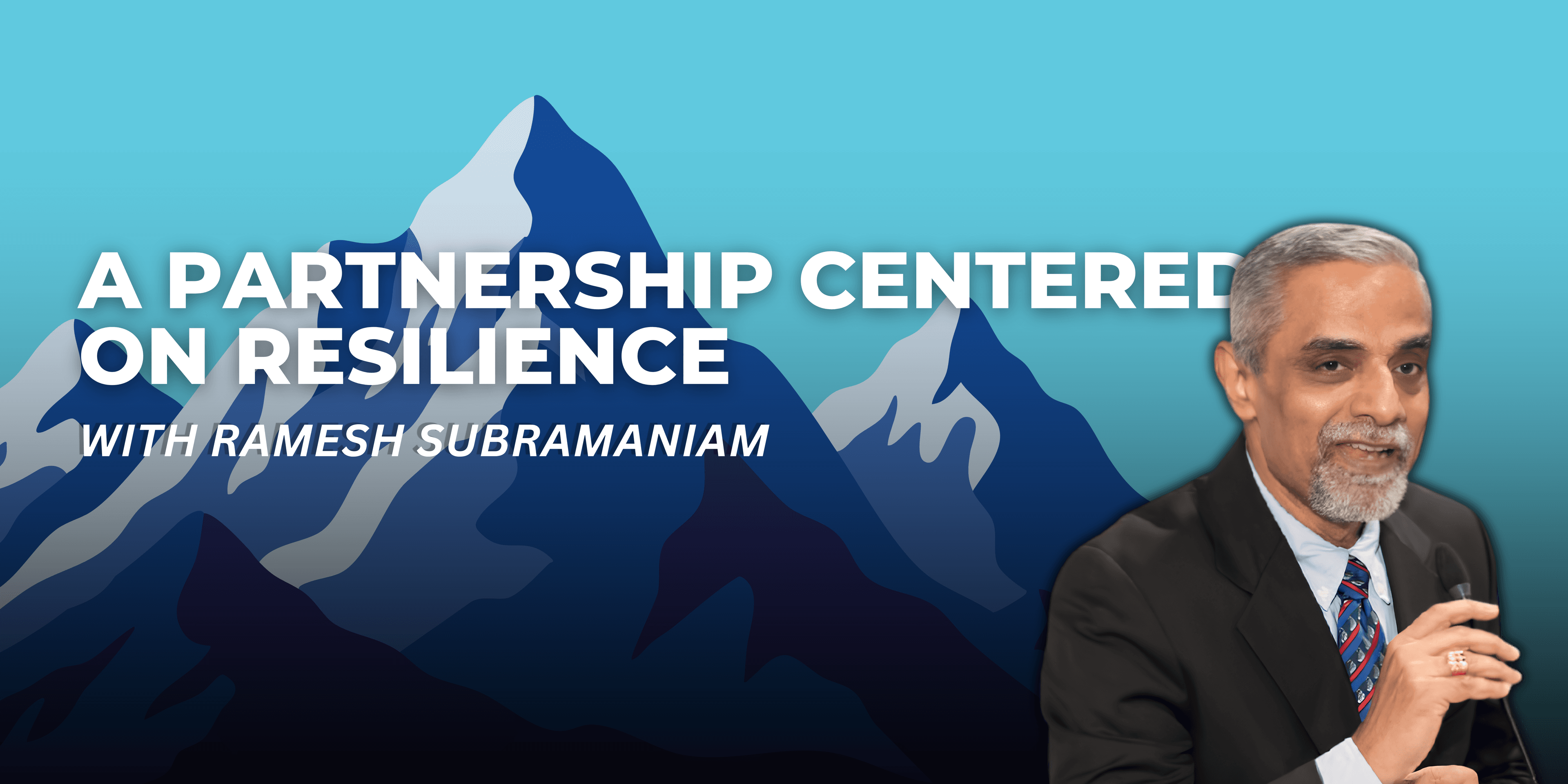
Continuing with the Leadership Series, BDN recently had the opportunity to speak with CDRI’s Global Director of Programmes and Strategy, Ramesh Subramaniam, about the role of resilience in infrastructure development. Subramaniam described the BDN-CDRI partnership as one built on strategic alignment. “For CDRI, collaborating with BDN is [a] high value addition project design and execution across the world will improve,” he said.
That alignment is mutual. CDRI brings together 57 member countries and 12 public and private sector partnerships. By 2050, the coalition aims to mobilise 10 trillion USD of new and existing infrastructure investments toward climate risk resilience, enhancing capacity, informing policy, and improving environmental quality and livelihoods for more than 3 billion people worldwide. CDRI’s mission to embed resilience into global infrastructure investment reflects a core value of the Blue Dot Network which views resilience as a fundamental risk mitigation tool.
The data supports this view. According to CDRI, over 169 billion USD was lost in 2025 to storms, floods, and earthquakes. Infrastructure that is ill-equipped to withstand climate shocks creates cascading risks, threatening economic stability and the welfare of entire regions. By contrast, resilient infrastructure delivers measurable returns. As Subramaniam noted, “Our work shows that $1 invested in resilience can have a return of up to even $12.”
This logic leads to one of CDRI’s central convictions: Subramaniam states, “Our premise is that resilient infrastructure will be bankable infrastructure.” Resilience, in this framing, safeguards against loss and is a signal of creditworthiness. Infrastructure built to withstand climate shocks in infrastructure that performs more predictably over its lifetime. This results in fewer service disruptions, lower maintenance costs, and reduced exposure to catastrophic loss.
For private investors, these qualities matter. Uncertainty is the enemy capital; resilience reduces it. By lowering the risk profile of a project and enhancing the reliability of its returns, resilience transforms infrastructure from a liability into a dependable long-term asset. Closing the global infrastructure gap, estimated to be 106 trillion USD, will require private capital at scale, and bankable infrastructure is how that capital is unlocked.
Yet, the impacts of resilience go further. Resilience is not only about de-risking or avoiding losses after a disaster. Resilience presents a value proposition: resilient infrastructure can protect future cash flows, reduce lifecycle costs, limit service disruption, preserve asset value and strengthen investor confidence in long-term bankability. Ultimately, building resilience functions both as a public good and as an investment opportunity.
However, despite this evidence, mobilizing resilience investment remains difficult. Subramaniam identified the core challenge: “resilience needs a lot of advocacy, capacity, risk analytics, and financial resources.” The reason is structural. The benefits infrastructure of are, by nature, preventative, prevention can be hard to see. A flood wall that holds, a bridge that survives a storm, a power grid that stays online during a heat wave: these outcomes register as non-events, even as they quietly deliver enormous fiscal value.
For the private sector, this matters significantly. Investment decisions hinge on confidence, confidence that a project has been designed to perform, that its risks have been properly assessed, and that its returns are dependable. BDN’s standards provide that assurance, creating a common language between project developers and the financier, insurers, and institutional investors whose participation is essential.
By certifying that infrastructure meets those standards, BDN reduces due diligence costs, lowers perceived risk, and makes it easier for capital to flow toward projects that might otherwise be passed over. As Subramaniam put it, “BDN’s work in this context, with its infrastructure standards and certification, is super critical,” not as a regulatory exercise, but as a practical tool for getting resilience financed and built.
We look forward to working alongside CDRI to advance a shared vision of infrastructure that is built to last, built to protect, and build for the people who depend on it most.
Watch the complete interview here on LinkedIn.